
Alcohol or Drug Impaired Driving
According to data from the Société de l’assurance automobile du Québec (SAAQ), drunk driving is one of the leading causes of accidents in Québec.
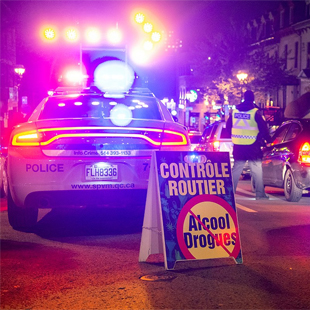
To reduce the number of motorists driving under the influence of alcohol or drugs, the SPVM conducts roadside checks at various times throughout the year.
The Criminal Code stipulates two situations in which a police officer may use an Approved Screening Device (ASD) to check for the presence of alcohol in a driver’s body:
- Mandatory alcohol screening: Under the Criminal Code, a police officer may randomly stop a driver and ask them to provide a breath sample in an Approved Screening Device (ASD), even if the officer has no suspicion that the person has alcohol in their system.
- When a police officer suspects that the driver has alcohol in their system, the driver must submit to a breath test using an Approved Screening Device (ASD) or perform the physical coordination tests prescribed by regulation. The driver is legally required to comply; refusal can lead to criminal penalties. If the driver fails any of these tests, they are arrested.
In case of suspected drug in their body, the driver is subjected to physical coordination tests prescribed by regulation, and if they fail, they are arrested.
Driving under the influence of drugs
Alcohol is not the only substance that can impair driving. Cannabis, illegal drugs, and even some prescription medications can impair driving ability.
Many drivers underestimate the consequences of driving under the influence of cannabis. However, the impacts are very significant, as you can see for yourself in the list below:
- Difficulty concentrating and staying alert to the road environment
- Impaired coordination
- Slower reaction time, slower reflexes and hesitant driving
- Risk of being unable to cope with unexpected events
Alcohol level
Did you know that a driver can be charged with impaired driving even if their alcohol level is below the legal limit?
In Canada, there are two criminal offenses related to drinking and driving:
- The first and most well-known situation occurs when a person operates a conveyance with a blood alcohol concentration of 80 mg of alcohol per 100 ml of blood or higher. This constitutes a violation of section 320.14(1)(b) of the Criminal Code.
- The second situation, provided under section 320.14(1)(a) of the Criminal Code, concerns cases where the ability to drive is impaired by alcohol to any degree. In other words, a person can be arrested and charged if alcohol impairs their driving ability, even if their blood alcohol concentration is below 80 mg per 100 ml of blood.
The number of alcoholic drinks consumed should never be the sole criteria for determining whether a person is fit to drive. What matters most is whether alcohol, even in small amounts, has impaired the ability to drive. This impairment can occur after the very first drink, especially when combined with other factors such as drug use, fatigue, stress, medication, or certain health issues (e.g., a cold).
These factors can amplify the effects of alcohol and compromise alertness, coordination, and judgment, even if the blood alcohol level is below 80 mg per 100 ml of blood.
Effects of alcohol
Alcohol primarily affects the central nervous system, impairing intellectual, sensory and motor functions.
Intellectual functions
These are the first to be affected by alcohol, which impairs attention, judgement, and self-control.
Sensory functions
Hearing, and especially vision, are affected by alcohol:
- Greater difficulty adapting to darkness and slower recovery from glare
- Altered perception of depth of field
- Decreased peripheral vision (tunnel vision)
- Double vision appears when blood alcohol levels reach 100 mg alcohol per 100 ml of blood (mg%), the phenomenon intensifies above 150 mg %
Hearing is also impaired when one is inebriated.
Motor functions
Alcohol impairs muscle control and coordination, leading to the following behaviours:
- Staggering
- Difficulty pronouncing words clearly
- Loss of manual dexterity
- Loss of precision in gestures and movements
Driving a vehicle is a complex activity that requires performing several tasks simultaneously. The driver must be able to perceive events, interpret them, and then react accordingly, which proves difficult when driving ability is impaired by alcohol.
Symptoms of alcohol impairment
Several of the symptoms described below occur when a person's driving ability is impaired by alcohol. Police officers observe these symptoms to assess whether an arrest is warranted. If you notice these symptoms in a loved one, try to convince them not to drive and, above all, do not get in the vehicle with them. If they still insist on driving, call 911!
- Irritated eyes
- Difficulty speaking
- Difficulty standing upright
- Difficulty walking in a straight line
- Slow gestures
- Distracted behaviour
- Slow responses to questions
- Tendency to fall asleep
- Increased feelings of sadness
- Signs of aggression
- Incessant and exaggerated laughter
- Faster breathing
- Increased sweating
- Accelerated speech
- Talking loudly
Sources: SAAQ and the École nationale de police du Québec
ZERO-ALCOHOL TOLERANCE FOR DRIVERS UNDER THE AGE OF 22
The zero-alcohol rule set out in the Highway Safety Code applies, among other things, to:
- All holders of a license of any class (car, motorcycle, etc.) and any type of license (learner’s permit, probationary license, driver’s license) who are under 22 years of age
- Holders of a learner’s permit, regardless of age
- Holders of a probationary license who do not hold any other class of license; in other words, a person in the process of obtaining their very first license, regardless of age
To know more: Zero-alcohol for drivers under the age of 22 – SAAQ
DRUG CONCENTRATION IN THE BLOOD
Any person who drives a motor vehicle or operates a conveyance (including care and control) while their ability to drive is impaired by drugs commits a criminal offence under section 320.14(1)a) of the Criminal Code.
Section 320.14(1)a) Criminal Code. Anyone who commits an offence:
Operates a conveyance (motor vehicle, boat) while their ability to drive is impaired to any degree by the influence of alcohol, drugs, or a combination of both.
A person can also be charged with a criminal offence if they drive with a certain concentration of drugs in their blood.
Here are three offences related to drug presence in the blood:
Anyone who commits an offense:
Section 320.14(1)c) Criminal Code (Combined offense – drugs)
Subject to paragraph (6), within two hours after ceasing to operate a conveyance, the person has a concentration equal to or greater than that established by regulation for that drug:
THC: 5 ng per ml of blood
GHB: 5 mg per L of blood
Any detectable level of the following drugs:
LSD, psilocybin, psilocin, PCP, ketamine, cocaine, methamphetamine, or 6-MAM (heroin metabolite).
Section 320.14(1)d) Criminal Code (Combined offense – combination of drugs and alcohol)
Subject to paragraph (7), within two hours after ceasing to operate a conveyance, a blood alcohol concentration and a drug concentration in their blood equal to or greater than those established by regulation for alcohol and that drug, where they are combined.
Alcohol: equal to or greater than 50 mg per 100 ml of blood
AND
THC: equal to or greater than 2.5 ng per ml of blood
Section 320.14(4) Criminal Code. Lower blood alcohol concentration (summary offense)
Subject to subsection (6), every person commits an offense who, within two hours after ceasing to operate a conveyance, has a concentration of a drug in their blood that is equal to or greater than the concentration prescribed for that drug, but less than the concentration prescribed for the purposes of paragraph (1)(c).
THC: equal to or greater than 2 ng per ml of blood but less than 5 ng per ml of blood
Key takeaway: Driving while impaired by drugs—or with certain drug concentrations in the blood—is a criminal offence under the Criminal Code, even at low levels or in combination with alcohol.
Arrest
Here is the sequence of actions that will follow an arrest for alcohol impaired driving:
- The police officer informs the driver of the violation that led to his arrest.
- The police officer reads the person their rights, including the right to legal counsel and their right to remain silent. The officer allows the person to contact the lawyer of their choice at the earliest reasonable opportunity
- In addition to the arrest, the police officer conducts a search of the person and the vehicle related to the type of infraction committed (a search incident to arrest).
- The vehicle is towed and impounded.
- The person is transported in a police vehicle to the SPVM detention center.
- Once at the detention center, the person is temporarily detained until tests are completed.
- If this has not already been done, the person may call their lawyer. If they do not have a lawyer, they may contact a Legal Aid lawyer or the Emergency Lawyer service.
- The person is taken to the breathalyzer room to provide the necessary breath samples to analyze their blood alcohol level.
- The person is released with a summons to appear, unless a public interest reason justifies keeping them in custody. The police officer also ensures that they do not pose a risk to themselves or to public safety before proceeding with their release.
- The summons to appear indicates the date of the court appearance as well as the scheduled date for fingerprinting and photographing
- Various administrative measures may apply immediately, depending on the circumstances:
- Vehicle seizure for 30 days if:
- The blood alcohol level is equal to or greater than 160 mg of alcohol per 100 ml of blood, or if the person refuses to provide a breath or blood sample.
- Or if, in the case of a repeat offense (second or subsequent offense), the blood alcohol level is equal to or greater than 80 mg of alcohol per 100 ml of blood.
- Immediate suspension of the driver’s license for 90 days if:
- The blood alcohol level is equal to or greater than 80 mg of alcohol per 100 ml of blood.
- Refusal to comply with a peace officer’s order to submit to a test.
Infractions and penalties
Driving while impaired can lead to severe penalties under the Criminal Code and the Highway Safety Code.
At the time of arrest, depending on the circumstances
- Immediate suspension of the driver’s license: 24 hours or 90 days
- Immediate seizure of the vehicle: 30 days or 90 days
After a criminal conviction (first offence)
- Criminal record
- Licence revocation: 1 year / 3 years
- Minimum fine: $1,000
- Risk reduction and assessment program (SAAQ)
- Alcohol ignition interlock device (depending on the situation)
To learn more : Penalties and costs for impaired driving - SAAQ.
Official Website of Service de police de la Ville de Montréal (SPVM)
© 2004-2026, all rights reserved
Welcome message |
|
|
العربية български Kreyòl Español Italiano ایران Português Deutsch ελληνικά Õ°Õ¡ÕµÕ¥Ö€Õ¥Õ¶ |
دری Fon ગુજરાતી Innu Lingala Türk Tiếng việt English Français |

I want to know about
Looking for specific information? View our information sheet: